

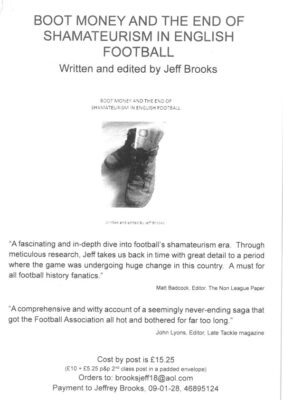
Renowned writer Jeff Brooks has recently written, and published, the book: ‘Boot Money and the End of Shamateurism in English Football’, depicting a period of amateur football that is often forgotten about. With BAFC even featuring, this book is a fascinating deep dive into a time period that carries significant interest.
A short summary of the book is below, provided by author Jeff Brooks himself:
Way back in 1885, the FA agreed to recognise professionalism in English football – players could be paid by their clubs. But, not amateur players. Payment to them was illegal under FA rules. But it happened and continued to happen for almost a century. For many years, notes and coins were placed in players’ shoes ( or boots ) in the changing room while a match was in progress and quietly pocketed when the match was over – boot money. In later years, the cash was surreptitiously handed out in brown envelopes – earned income but no Income Tax or National Insurance deductions. The players were sham amateurs – shamateurs.
By the early 1970s, top “ amateur “ players in the top “ amateur “ leagues ( the Isthmian, Athenian and Northern ) were regularly being paid around £30 per week – equivalent to around £500 today. Understandably, players considered their boot money as a second income – useful for covering a mortgage ! It is likely that the elite players were being paid up to £50 per week by their clubs, plus a Summer “ retainer “. No wonder that so many “ amateur “ players, despite having the ability, decided against playing professionally as it most likely would have resulted in a drop in income. Additionally, if a professional career did not work out, a player could not, under FA rules, ever play again for an affiliated amateur club and, of course, collect his boot money.
The payment of boot money and, often, other benefits, was widely known by all involved in the “ amateur “ game and the FA were, at times, informed of alleged misdemeanours and had no option but to investigate. In 1928, Northern League Bishop Auckland claimed that Crook Town were “not a properly constituted amateur club“ (i.e. they were paying their players ). The FA investigation resulted in over 300 players and 61 officials registered with the Durham FA being suspended and fines totalling £385 being imposed.
However, boot money continued to be paid with impunity, with the FA regularly, and improbably, claiming that there was insufficient evidence to investigate allegations.
In 1963, The People newspaper revealed that the result of a Division One match between Ipswich Town and Sheffield Wednesday in 1962 was fixed as part of an illegal betting operation. The FA had to investigate and this resulted in 33 players being prosecuted in the criminal courts. Some imprisonments , including to international players, were imposed and the FA applied lifetime bans to the guilty players. The ringleader, former player Jimmy Guthrie, was sentenced to four years’ imprisonment. This case clearly concerned FA officials who may have been worried that the next scandal to be revealed in the national press would be the payment of boot money to “ amateur “ players.
In March 1963, The FA Council accepted a recommendation from the Amateur Selection Committee and the Amateur Cup Committee that a Shamateurism Committee be established. The new Committee met for the first time at the FA’s HQ in Lancaster Gate, London in June 1963. This was later renamed the Alleged Payments To Amateur Players’ Committee and, subsequently, the Amateur Status Committee.
After many meetings and much prevarication, disingenuousness and repeated claims that there was insufficient evidence to warrant a change to FA rules, the FA Council formally decided in 1972 to abolish the distinction between amateur and professional footballers. All would now simply be “ players “. The change of policy was implemented for the start of the 1974/75 season. All clubs could now legally pay their players if they wished to do so.
My book, “Boot Money and the End of Shamateurism in English Football “ explores the long history of this fascinating and convoluted episode in English football.
The book can be bought directly from me and the cover price is £10. However a £5.25 postage and packing charge will apply (second class post in a padded envelope).
If you are interested or have any questions, please contact me at: brooksjeff18@aol.com
Jeff Brooks